|
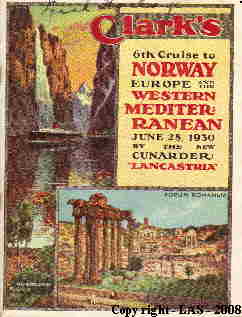
CLARK’S 6th CRUISE to NORWAY, EUROPE and the WESTERN MEDITERANEAN - a review of a 1930s holiday booklet and firm that gives a detailed insight into life an attitudes of some of Lancastria’s peacetime passengers, written just 10 years before the liners fateful demise.
It was a different era, with different social values and standards. Some good and some that would be decidedly unacceptable to society today. Yet Frank C. Clark’s booklet review of the “6th cruise to Norway and Western Mediterranean written in June 1930 gives a unique insight into everyday life aboard the Lancastria for passengers of the day.
Written essentially as an advertising tool for Cunard, the Clark booklet details a 52-day voyage starting on the 28th of June 1930 in New York and finishing in Le Havre, taking in along the way Morocco, Spain, Naples, Rotterdam and Oslo before heading south westerly to Leith in Edinburgh and then down to Southampton and onwards to Le Havre. Thereafter the Lancastria crossed the Atlantic again and returned to New York.
Frank C. Clark, accompanied by his wife, were pioneers of the travel agent industry. They specialised in cruising holidays, promoted them, organised and chartered the liners which would take, mostly, rich American passengers to “exotic” locations around the world. Clark’s Cruises were then based in the Times Office, Broadway and 42 Street, New York, but they also had offices in Cairo, Haifa, Jerusalem, Paris and London. Interestingly the London office was owned by Pickfords, the removal company.
By 1930 Clark’s had organised 25 cruises to the Mediterranean and 8 “around the world” trips on various vessels. By 1930, 35 years after being established, Clark’s had provided cruises to over 25,000 Americans giving them “unprecedented distinction” and “representing the climax of all deluxe cruising.
 The cruise of June/July 1930 was the 6th one organised by the Clarks aboard the Lancastria. The earlier cruises, taking in the same sights, ran consecutively from August, 1924 to 1930. The cost of these cruises depended on the requirements of passengers, but ranged from $600 to $1250 at 1930 prices. In 1930, for comparison, the average weekly wage of a Doctor in the US was $61.51, so the prices of these cruises were aimed at the very wealthy in American society. In today’s terms (2008 prices) the cost would range from £8,500 to whopping £17,800 for the first class accommodation, a cost Clark’s describe as “wonderfully low rate”! In all passengers would travel 12,225 miles and a further 700 miles by rail when the Lancastria docked and allowed passengers to explore the various countries on day excursions. The cruise of June/July 1930 was the 6th one organised by the Clarks aboard the Lancastria. The earlier cruises, taking in the same sights, ran consecutively from August, 1924 to 1930. The cost of these cruises depended on the requirements of passengers, but ranged from $600 to $1250 at 1930 prices. In 1930, for comparison, the average weekly wage of a Doctor in the US was $61.51, so the prices of these cruises were aimed at the very wealthy in American society. In today’s terms (2008 prices) the cost would range from £8,500 to whopping £17,800 for the first class accommodation, a cost Clark’s describe as “wonderfully low rate”! In all passengers would travel 12,225 miles and a further 700 miles by rail when the Lancastria docked and allowed passengers to explore the various countries on day excursions.
The 6th cruise took in Madeira, Casablanca and Rabat in Morocco. It offered a variety of on board entertainment such as lectures, dances, concerts along with special clubs such as the “Camera Club”, “Travellers’ Club” and even a club for any Masons on board.
|
“These cruises are composed exclusively of representative Americans, without the constant addition of uncongenial foreigners” - Extract from Clark’s 1930 promotional booklet
|
In the introductory blurb, the Clark booklet makes an unusual, and what would be regarded today as unacceptable pitch to potential cruise tourists:
“These cruises are composed exclusively of representative Americans, without the constant addition of uncongenial foreigners at the various Mediterranean ports.”
Given the wealth of the passengers who would undertake the cruises it seems remarkable that the booklet goes on to add:
“Passengers are earnestly requested never to fee the guides, drivers or hotel servants as they are liberally paid by us.”
Single ladies travelling alone were well catered for during the cruise as Clark himself describes:
“Experienced chapersons and hostesses will give counsel and help ladies travelling alone and the Social Directress and assistants will manage the dances and care parties, etc. We wish to make the social life on shipboard the same as it would be on a private yacht.”
Click here for PART 2
|