Lancastria Lifeboat Survives?
In June 1990 an article appeared in the Sunday Telegraph that indicated that one of Lancastria's lifeboats did actually make it back. Survivor Norman Diver who went to check out the story was left in little doubt that the large beached boat at Walney Island off Barrow-in-Furness was from the Lancastria.
Examining the pink, bleached hull, which was intact except for a hole in its side, Norman Diver insisted "It's from the Lancastria. There's no doubt about it." Norman had travelled from his home in Totington, Greater Manchester. It's built the same way as those on the ship and has '99' carved on it - the number of men it could carry."
The Lancastria had 32 lifeboats, each about 30 ft long. Author John West agreed with Mr Diver that the lifeboat at North Scale, Walney Island, was from the Lancastria. Mr John Littlewood who intended turning it into a houseboat rescued it around 1960 from a Barrow scrap yard.
One of Mr Littlewood's friends, David Pollock said: "on its bow at one time was the inscription 'Lancastria 99 men'."
Recently Mark Hirst contacted Mr Pollock who still lives in Walney Island he said that the lifeboat was left at the bottom of the village, just up from the beach. It was in a poor state of repair with only the gunnels and outer skin left. The lifeboat had originally been double skinned.
Mr Pollock confirmed that Mr Littlewood, the owner of the lifeboat, had intended to transform the vessel into a houseboat, but it proved too big a job for him and after his death no more work was done on the boat. He also understood from Mr Littlewood that for a short time the lifeboat had been used on a smaller ship before ending up in the scrap yard in Barrow.
On the 11th of May 2001, Mark Hirst travelled down to North Scale, Walney Island to see the lifeboat for himself. His father, John, joined him for the 300 miles round trip. As they drove up towards the village of North Scale, they could see from the road a white and quite dilapidated boat shell, laid-up at the top of the beech near to the road.
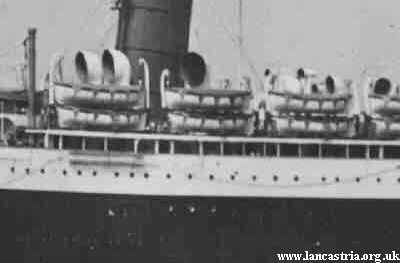
Close up of Lancastria's lifeboats
The boat, which had obviously been there for some time was being used as a makeshift skip with empty gas bottles and old guard railings thrown inside.
No distinguishing marks were visible anywhere on the hull. The boat was of clinker construction with the outer boards running horizontally along its length. The rudder showed signs of major damage and generally the vessel was in a poor state of repair with numerous small holes along the rotting wooden sides. Two wooden posts were positioned near to both stern and bow and its possible that these would have been originally attached to the rigging of the davits.
After taking some photographs of the vessel Mark spoke with a man who was about to take his own boat out for a spot of fishing. He asked him if he knew anything about the vessel. He said he knew the owner, a David Douglas, and that he was intending to break up the remains of the boat over the next few months as it was beyond repair. Mark asked if it was a lifeboat from the Lancastria, which the fisherman confirmed. When Mark mentioned that John Littlewood had been the owner, the gentleman denied this and said that Littlewood did have an old lifeboat which had come off a dredger, but it was up at the top end of the village.
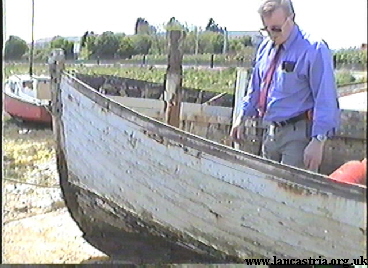
The first lifeboat
Immediately doubts began to be raised as to the authenticity of the lifeboat they had just examined. Although what remained of the vessel did match the dimensions of one of Lancastria's lifeboats, clearly the ownership and statement from this individual did not. Their suspicions were that the other lifeboat referred to was actually from the Lancastria as the Telegraph article had stated and that a number of survivors had come to see and given it a 'positive identification'.
Father and son travelled on, up through the village, down Teasdale Road and along a dirt track to where a number of yachts and smaller vessels were lying on the sand. The tide was fully out. Next to one of the large yachts were the remains of a vessel lying in an extremely poor state.
Around 60% of the boat was completely missing but the stern section was largely intact. The outer skin construction of the boat was unknown to them but certainly not clinker built. The outer planks ran vertically down at the stern. Rusty rope rings were still hanging at regular intervals along the side and large metal rolex could still be seen. This vessel, at one time, had been a far more substantial boat although it had clearly taken a battering over the years.

The second lifeboat
Another man working on his yacht, alongside the wreck, confirmed that it had once belonged to John Littlewood and since his death the boat had been left to fall into its current state.
At the time and considering the evidence available it did seem likely that this was indeed what remained of a lifeboat from Lancastria. The survivor statements in the 1990 Sunday Telegraph article, the claim by David Pollock, Littlewood's friend that originally the boat had the name "Lancastria" on her side and the high quality construction, all pointed to the fact that the second lifeboat they saw had come from the Lancastria.
However once Mark compared the still images with original photographs of Lancastria's lifeboats it became apparent that the second boat did not fit the construction type of Lancastria's lifeboats which were clearly of clinker construction.
Mark then went back to the first lifeboat and using Imaging Software superimposed a close-up of the bow with a photograph of one of Lancastria's original lifeboats. They matched.
So now they had two lifeboats with a Lancastria connection. Serious doubts now began to be raised as to how the eyewitnesses could be so wrong. It is possible that when those Lancastria survivors visited North Scale in 1990 and came across the first lifeboat, visible from the road, they mistakenly thought it belonged to Littlewood, but convinced by the design and colour of the vessel were able to give a 'positive identification'.
It is also possible that the unnamed gentleman with whom Mark spoke to next to the first boat was mistaken as to the ownership and its origin. There is even a possibility that neither of the boats at North Scale came from the Lancastria.
There are also questions about how the lifeboat would have made it back after the sinking. According to Captain Sharp only five or so lifeboats were successfully lowered before the Lancastria sunk. Once the men inside these had been disembarked on to larger vessels such as the Oronsay what would have happened to the empty lifeboats? Would they simply have let them float away?
After the sinking of the Titanic in April 1912, the Carpathia, the liner which picked up most of the survivors, strapped the empty lifeboats to her side before heading for New York. It does seem logical that once the Lancastria's lifeboats were emptied following the sinking, that some attempt would be made to secure the boats to the larger vessel, particularly in the case of the Oronsay which, like Lancastria, was heavily overloaded.
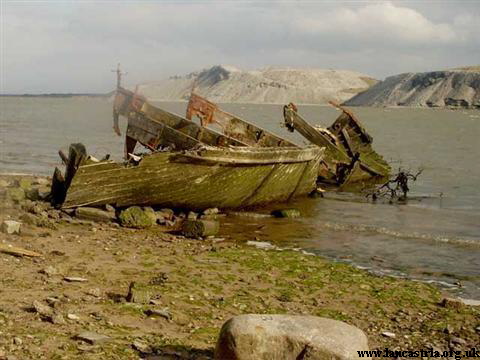
(Above, the second lifeboat shows its age. This picture taken in 2005)
There are gaps in the story of the lifeboat, or boats, at North Scale. According to Littlewood's account he picked them up around 1960 at a scrap yard in Barrow. So where was the boat from 1940 to 1960? The second boat fits the description given in the Telegraph article, however the construction does not match the design of any of the lifeboats from the historical photographic archives. The second lifeboat was identified as once belonging to Littlewood by the yachtsman Mark spoke with.
Lack of any kind of identifying marks on either lifeboat leaves a certain degree of doubt.
If one of Lancastria's lifeboats does actually exist at North Scale then it is likely to be the first of the two boats examined.
In any event the mystery may never be solved. Weathering and tide are gradually reducing the second lifeboat to a few unidentifiable pieces of timber and the first lifeboat, the most likely of the two, is to be broken up by its owner later this year.
Lancastria, it seems, does not give up its secrets easily.
UPDATE:
Speculation about the origins of a wrecked lifeboat at Barrow-In-Furness continues.
A visitor to this website who lives in Cumbria contacted the Association, initially with doubts over whether the lifeboat wreck was from the Lancastria. Brian Singleton initially contacted Mark Hirst to say that the boats came from the breaker's Barrow facility in the early 1950s by Thomas Ward the well known shipbreakers. It was thought at first they came from the SS Duke of Lancaster. Brian's brother spoke to the man who bought the second of these boats which he converted to a cabin cruiser which is thought still to be in use.
The lifeboat at North Scale is now showing its age after years of neglect.
The second boat now rests at North Scale and is the one seen in the photographs.
Brian said: "According to the local part time coast guard at Walney, Brian Person, the lifeboat at North Scale did come off a ship broken up at Wards in the early 50s, but the lifeboat itself had originally come from the Lancastria and still carried the name.
"Apparently during the war years it was common practice to fit different ships with additional lifeboats from ships that had been sunk in action. The coastguard also said that a piece of wood from this lifeboat was to sent to Australia to be presented to a survivor of the Lancastria and due to the strict Australian quarantine rules on plant and fruit it had to get special permission to be imported! Due to the historical significance however permission was finally granted.

Lifeboat drill aboard Lancastria. This rare photograph shows Lancastria crewmen preparing for the worst. On the 17th of June 1940 less 10 of Lancastria's 32 lifeboats got away in time according to Captain Sharp. (click on picture to see bigger image)
"The other lifeboat which was converted is no longer in Barrow. It was purchased by a buyer from elsewhere. Its name was the "Largo" and it was bought in the 1980s."
Certainly this does seem to fit with the local news story but the evidence, limited though it is, suggests this lifeboat could indeed be from the Lancastria.
|













