Lancastria's funnel
Did a bomb go down the funnel of Lancastria? The evidence suggests not.
Many eyewitnesses have claimed that during the attack on the Lancastria they saw one of the bombs going directly down the funnel. It is clear however that this did not happen.
Frank Brogden a member of Lancastria's crew was an engineering officer at the time of the sinking. In his account of the sinking he dismisses the recurring claim that one of the four bombs dropped, went down the funnel. According to Brogden if this had happened the explosion would have destroyed the boiler room and engine room platform, immediately below the single funnel.
As he was standing on the engine room platform at the time the ship was hit he is perhaps best placed of all to discount the numerous witness accounts which claim that they had seen the bomb go down the funnel.
There is also the more technical issue of being able to drop a 500kg bomb directly down the funnel. Considering the Ju 88 was travelling at over 200 miles per hour and given the trajectory of the bombs as they fell, together with the sloping design of the funnel, even if the bomb had entered the upper portion of the funnel it would have almost certainly smashed through the relatively thin metal casing and ended up on the roof of the staircase housing, immediately in front of the funnel on the boat deck.
So why should so many of the survivors claim to have seen this? There are a number of possibilities. Firstly, many of the survivor accounts which state that this is what happened, if read carefully, do not actually claim that they witnessed it.
Only a Stuka dive bomber would have been able to drop a bomb vertically down the funnel of Lancastria, but Stuka's were not responsible for the attack that day.
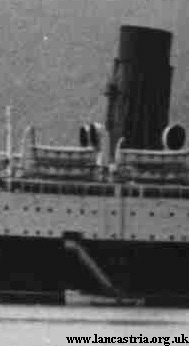
It is also possible, depending on exactly where survivors were located on the ship, that the bomb did appear to enter the funnel. Given the confusion at the time, the noise of many guns firing away at the attackers combined with the fact that the funnel was, for the most part, obscured by thick black smoke due to Captain Sharp's order to have the liner ready with "steam up", may well have led to many thinking that they saw the bomb enter the funnel.
It is more likely that this bomb actually fell very close to the funnel and entered hold number 4 immediately behind the bridge. It is likely that the Ju 88 of KG30, the unit which bombed Lancastria and who specialised in anti-shipping operations, were at least hoping to disable the ship by destroying the bridge as they had done with the Oronsay earlier that day. The other bombs landed in Number 2 hold, Number 3 hold and a fourth in the water on the Portside. This last bomb caused severe underwater damage and water could be seen flooding into a hole torn in the side of the vessel.
Interestingly both Captain Sharp and Chief Officer Grattidge have stated in their accounts of the sinking that the bomb went down the funnel despite the fact that neither was on the bridge at the time of the attack. This was not unusual in itself given that both men had been on duty during the overnight sailing down from Brest, however it does highlight the difficulty of accurately disseminating information from individuals who could be reasonably described as expert witnesses.
Immediately after the attack Grattidge heard crew on the bridge calling down to the engine room, but communications had been severed and this, together with misleading eyewitness accounts probably led both Sharp and Grattidge to presume that the engine room had suffered a direct hit. All of the crew in the engine room, situated two-thirds of the way down in the ship, escaped via an engineering duct which ran all the way up to the main deck of the ship.
The official report into the sinking of the Lancastria has never been located. Undoubtedly it would have some conclusions about what actually took place, who was ultimately responsible for issuing the order to disregard international law on passenger limits and why a liner of Lancastria's size, over 16,000 tons, sunk in just 20 minutes when her bulkhead doors were meant to be closed. It had been believed that this report was held under the Official Secrets Act until 2040. However the Admiralty, Cunard, the MoD and the Official Records Office deny this, yet none are able to locate what has happened to the official report into the worst naval disaster in British history!
Harry Grattidge helped compile the Official Report into the disaster. Grattidge is categorical about the existence of such a report and in his own account published some years after the sinking he talks about meeting up with Captain Sharp in Liverpool and there "...we prepared the official report of how the Lancastria had gone to her death." (Source "Captain of the Queens" by Harry Grattidge)
So the mystery of where that report is will remain, for the time being at least, exactly that - a mystery.
|













