Lancastria Book Reviews
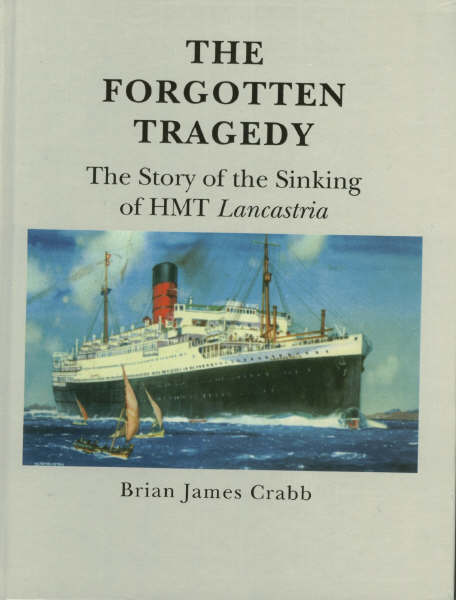
THE FORGOTTEN TRAGEDY
- The story of the sinking of HMT Lancastria, by Brian Crabb - 2003
Review by John Armstrong, Thames Valley University
This well-illustrated volume is not aimed at an academic readership but rather at the survivors of this tragedy, their families and friends, and the relations of the many who perished when this liner was sunk. Thus it is a form of memorial to that loss and a labour of love on the part of the author, who had no direct or indirect involvement in the incident, but became determined to tell the story of the disaster.
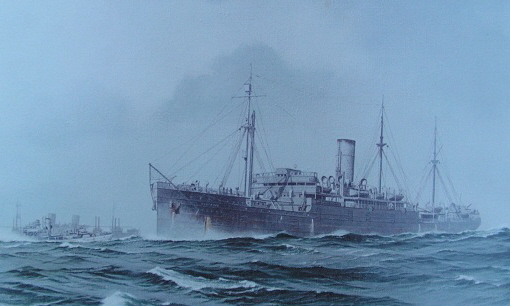
The story is soon told. In June 1940, as part of the withdrawal from France in the face of the invading German army, the Cunard White Star liner, Lancastria was sent to Charpentier Roads, just outside the port of St Nazaire, to embark soldiers and airmen and bring them back to Britain. While anchored there and virtually fully laden with troops a German JU88 bomber scored several hits on the Lancastria, including one bomb down the funnel and a couple in the holds. As a result the liner rolled over onto her port side and sank in about twenty minutes. The precise number who died cannot be known. The ship was carrying about 6000 people and at least 2000 are known to have perished, but given the circumstances accuracy is impossible. What is certain is that this incident rates as the worst ever maritime disaster to take place to a British merchant ship in the Second World War, indeed 'the worst disaster in Britain’s maritime history'.
This tragedy has never been written up properly and Crabb’s book although not the first volume devoted to this topic is the most comprehensive. It is a combination of narrative from the author and statements from the survivors, some of which have appeared in print before, but this is the first time that all the data has been gathered together in one place. The book, as befits a tribute to the memory of heroism and courage as well as disaster, has a roll of honour of all those who are known to have lost their lives in the calamity, a listing of all honours awarded as a result of the incident, the captain’s career details, newspaper reports, and even a menu of the lunch that day, which seems quite out of place. There is an impressive bibliography of both manuscript sources from the PRO, Guildhall Library and other sources, and also a list of relevant published works. There are full picture credits, but no referencing system to show where the quotes and precis come from, which detracts from its academic value.
The book is very successful, in that it achieves what it set out to do, namely to provide in one volume all that is recorded and remembered about this terrible loss. Its target audience should be pleased with its comprehensiveness, sensitivity, and attention to detail. It is a fitting memorial to those who lost their lives and testimony to the acts of bravery, defiance and endurance which occurred. The eye-witness and participant statements give the text an immediacy and vividness.
It is also important to stress that although this was the worst disaster to occur to a British merchant ship in the Second World War, it was not the worst of the war. That unhappy distinction goes to a number of German ships which were sunk in 1945, sustaining casualty figures two or three times those of the Lancastria. These tragedies included the loss of the Goya, Cap Arcona and Wilhelm Gustloff. Crabb acknowledges these in an appendix but it might have been stressed in the text itself. It, of course, in no way lessens the tragedy, but puts this case study in a wider context.
Are there other wider lessons to be learnt from this event? The glaring one is how vulnerable ships were to air attack and how essential it was to have air cover. The second is the need for easily launched rafts and adequate numbers of life-belts or jackets and the third was the danger involved with carrying large quantities of fuel oil. Nothing could be done about any of these in the short run and, given the speed and magnitude of the German attack, risks were taken to bring the British troops home.
Webmaster review:
Brian Crabb's book will undoubtedly prove to be the seminal and definitive story of the sinking of the Lancastria. The research and work which Brian has put into this book can be seen on every page. The Forgotten Tragedy tells the full story of the Lancastria and is the perfect starting point for anyone wishing to know all of the aspects to this horrific disaster. As a historical resource it is truly immeasurable and contains for the first time a full list of all those victims known to have been aboard Lancastria on the 17th of June 1940.
If you only ever read one book about the Lancastria, make sure you read this one. - Mark Hirst
Other recent titles by naval historian Brian Crabb
BEYOND THE CALL OF DUTY
The loss of British Commonwealth mercantile and service women
at sea during the Second World War
by Brian James Crabb
Review by Simon Harding Western Daily Press, July 2006
Bristol garage-owner and naval historian extraordinaire Crabb has carved a unique career documenting some of the forgotten tragedies of World War II at sea. His definitive work on the SS Khedive Ismail opened a whole new subject for him - the role of the many brave women who put to sea alongside male colleagues and ran the gauntlet of U-boat and air attacks.
Hours after Britain and France had declared war on Germany , the Donaldson liner Athenia was torpedoed and sunk by a German U-boat in the Atlantic with the loss of four stewardesses (Simon had put men!)
Although the book is truly massive in scope, and the appendices apparently endless, it is never dull and the all-too human detail is at times frightenly imaginable - for instance, out hearts go out to the plight of the poor woman dragged into a lifeboat after one merchant ship sank to find that all four of her children were missing.
In fact, it is the suffering of the youngsters who occasionally found themselves adrift for days or even weeks, that stand out like beacons in the relentless descriptions of bombings and sinkings.
A fascinating and worthy tribute, filled with Crabb's trademark eye for human tenderness and the will to survive at all costs.
Click here for more titles from Brian Crabb and information on how to order your copy
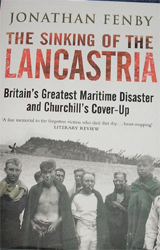
THE SINKING OF THE LANCASTRIA
Britain's Greatest Maritime Disaster and Churchill's Cover-Up
by Jonathan Fenby
Published by Simon and Schuster UK Ltd May 2005, £14.99 in hardback - paperback out soon
A superbly gripping re-creation of the greatest maritime disaster in British history: the sinking of the Lancastria during the fall of France in 1940.
The sinking of the Lancastria led to the greatest loss of life in British maritime history -
yet because of the government cover-up ordered by Churchill himself, the disaster it is a story that has never been properly told
· To put the scale of the tragedy in to perspective, more people died on the Lancastria than on the Titanic and the Lusitania combined
· Publishing in May, The Sinking of the Lancastria will commemorate the 65th anniversary of the 17th June 1940 tragedy
· The book also brilliantly describes the amazing chaos and panic of the days after Dunkirk - when around 150,000 British troops were still in France
A fortnight after the evacuation at Dunkirk some 150,000 British troops were still stuck in France. As the German advance thundered west these Allied soldiers and airmen were faced with a mad dash to the coast in the hope that a troopship awaited them there. One such vessel was the Lancastria, a 16,000-ton liner pressed into service and now anchored off the port of St-Nazaire. On the 17th June 1940, ready to head for home, the ship was bombed by the Luftwaffe. As she sank, between 3,500 and 4,000 of those on board lost their lives.
Re-creating this extraordinary episode with great narrative flair, Jonathan Fenby shows us not just the human stories behind the disaster but the cover-up that followed - as Churchill ordered a blanket ban on news stories for the sake of the country's morale.
Gripping and moving, LANCASTRIA tells one of the great forgotten stories of the Second World War.
Jonathan Fenby is a former editor of the OBSERVER and of the SOUTH CHINA MORNING POST. He is the author of several books including the acclaimed ON THE BRINK: THE TROUBLE WITH FRANCE and GENERALISSIMO: CHIANG KAI-SHEK AND THE CHINA HE LOST.
For further information please contact Digby Halsby
on 020 7316 1981 or email
[email protected]
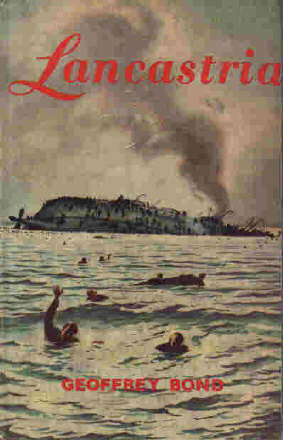
Bond, G., LANCASTRIA, Oldbourne, 1959.
Arguably one of the most detailed written accounts published and the first book ever published on the subject.
This book which is now sadly well out of print, comprises of numerous individual accounts which have been seamlessly weaved together by the book’s author Geoffrey Bond.
The book also contains a large number of photographs. Well worth checking out the library archive to see if they have a copy gathering dust, where some have been known to rest undisturbed for decades.
Grattidge, H., CAPTAIN OF THE QUEENS, Oldbourne, 1951
This is a very personal account of a sailor’s life by the former Chief Officer of the Lancastria, Harry Grattidge.
Numerous references to the Lancastria throughout the book give an indication of the impact on Grattidge who went on to become Captain of the Queen Mary and finally the most senior position within the Company as Commodore of Cunard. This book is also sadly long out of print.
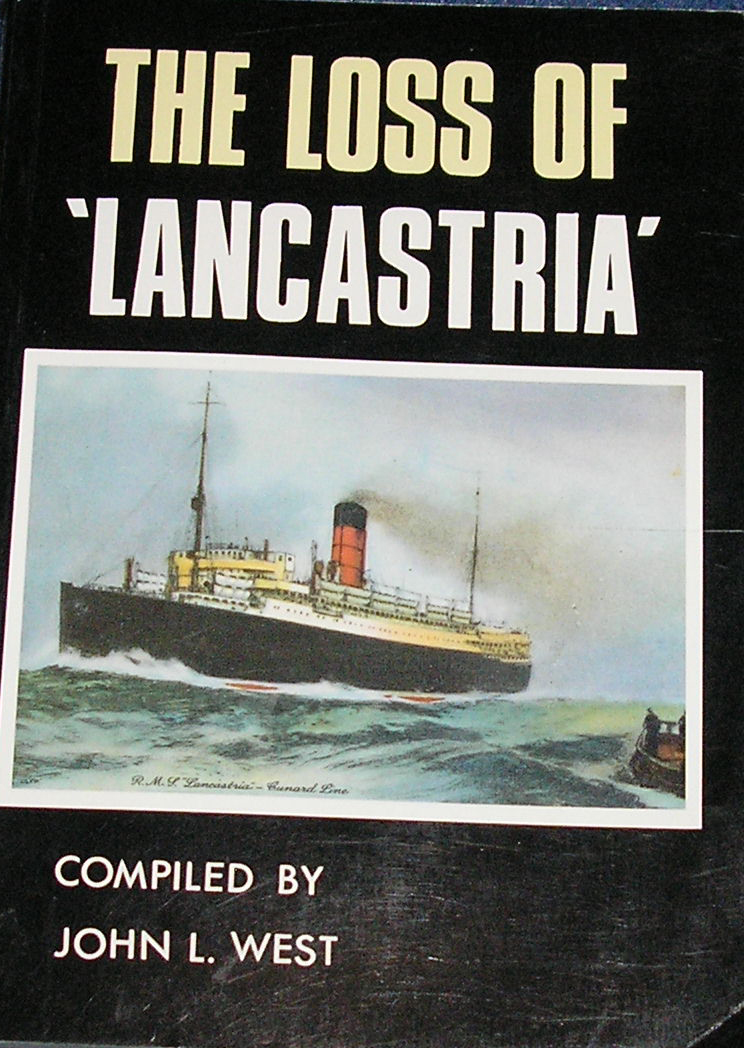
West, J.L., THE LOSS OF THE LANCASTRIA, Millgate, 1988
A collection of predominantly survivor accounts. The book is worth reading although numerous typographical errors do make it hard going at times. Copies regularly appear at reduced rate on Amazon and other book sellers.
Boutin, E., Les Grand Naufrages de l’estuary (The great disasters of the estuary [Loire]) ISBN 2-907967-92-4 - 1992
Fascinating and insightful. Emile Boutin’s account of the sinking, written in French of course, includes a number of survivor accounts and a significant number of accounts written by the skippers of the French rescue craft which took part in the operation to save survivors and recover victims. Well worth a read if you get the chance.
Emile is one of the region’s most celebrated authors and historians with a range of books under his belt. His research has been meticulous and his contribution significant to better understanding this period of history.
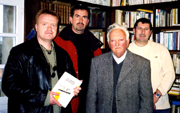
Above, Mark Hirst holding a copy of the book, Christophe Francois, Emile Boutin and Yves Beaujuge, April 2004
Perruchon, J., Juin 1940 - Sur les Cotes charentaises, 2005
A very interesting French account of the retreat through France by the British Army which also chronicles the cemeteries around the coast which hold victims of Lancastria.
Clarke, C., HMT LANCASTRIA NARRATIVES, 1998
There are now two sets of survivor and eyewitness narratives which have been put painstakingly together by Colin Clarke.
These accounts give a very good impression of the events of 17th June and are an ideal primary source of information for anyone wishing to research the story further.
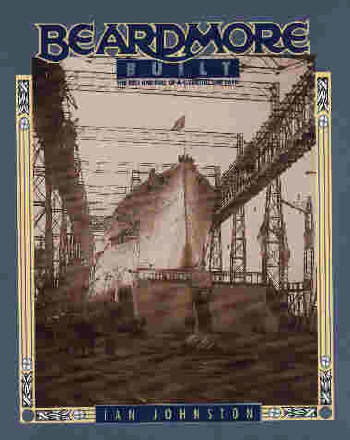
Johnston, Ian, BEARDMORE BUILT, Clydebank District Libraries and Museums 1993, ISBN 0 906938 08 2 - 2004
A very detailed account of the Dalmuir Yard on the River Clyde with a number of pictures of the Lancastria (then the Tyrrhenia) during her construction.
The book’s author appears to be unaware of what became of the Lancastria and there is no mention of the disaster. Nonetheless this book is a very good read with numerous pictures of Lancastria’s birthplace and very good close-up shots of Lancastria being fitted out.
Goss, C., THE LUFTWAFFE BOMBERS’, Crècy, 2000, ISBN 0 947554 82 3 - 2001
An absorbing book about Luftwaffe air operation during the early part of the war. Chris Goss, the book’s author is a serving officer with the RAF and his detailed research gives an idea of the mentality of bomber crews during that time.
Still in print and available.
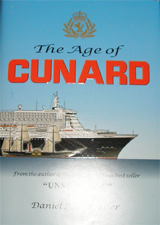
Butler, D.A, The Age of Cunard ISBN 1-57785-348-2
They say imitation is the greatest form of flattery, so the webmaster felt very flattered when he read Daniel Butler’s account of the Lancastria sinking in this book which covers the history of Cunard. The book is endorsed by the company and covers the 160-year history of the shipping line which operated Lancastria. The webmaster bought a copy at £22 and quickly went to the section covering Lancastria only to discover that it was taken, virtually word for word, phrase for phrase from this website…! There is however one, never before published photograph of Lancastria taken in her cruising all white colours, only one of two known to have been published. The rest of the book is interesting, but if you are researching only the Lancastria, then save yourself £22 and read the original pages on this website.
|